A game of knowledge
Golokdham belongs to a much older Indian family of spiritual journey games generally known as Gyan Chaupar, the “Game of Knowledge”.
In these games the board was more than a race track. It represented a map of existence, with different states of life, conduct and consciousness connected through advancement and regression.
The specifically Bengali form known as Golokdham appears to have emerged considerably later. Surviving evidence points to nineteenth-century Bengal, probably around the 1870s.
Historical research connects early Golokdham boards with Bengal’s flourishing print culture, including the Battala and Garanhata-Chitpur printing world of Calcutta.
A Golokdham board collected for the Indian Institute at Oxford in 1884 was reportedly described as a game “lately invented”. This strongly suggests that the Bengali Golokdham was still relatively new during Sri Ramakrishna’s lifetime, although the spiritual-game tradition from which it developed was far older.
The board transformed
A distinctive Bengali transformation
Golokdham retained the spiritual-journey principle of Gyan Chaupar but transformed it substantially.
The historical form reconstructed here contains 64 cells. The lower board consists of 48 cells arranged in an 8 × 6 grid. Above it the board progressively narrows through rows of 6, 4, 3, 2 and finally 1 cell.
Golok occupies the apex. Movement follows one uninterrupted serpentine sequence from Cell 1 to Cell 64.
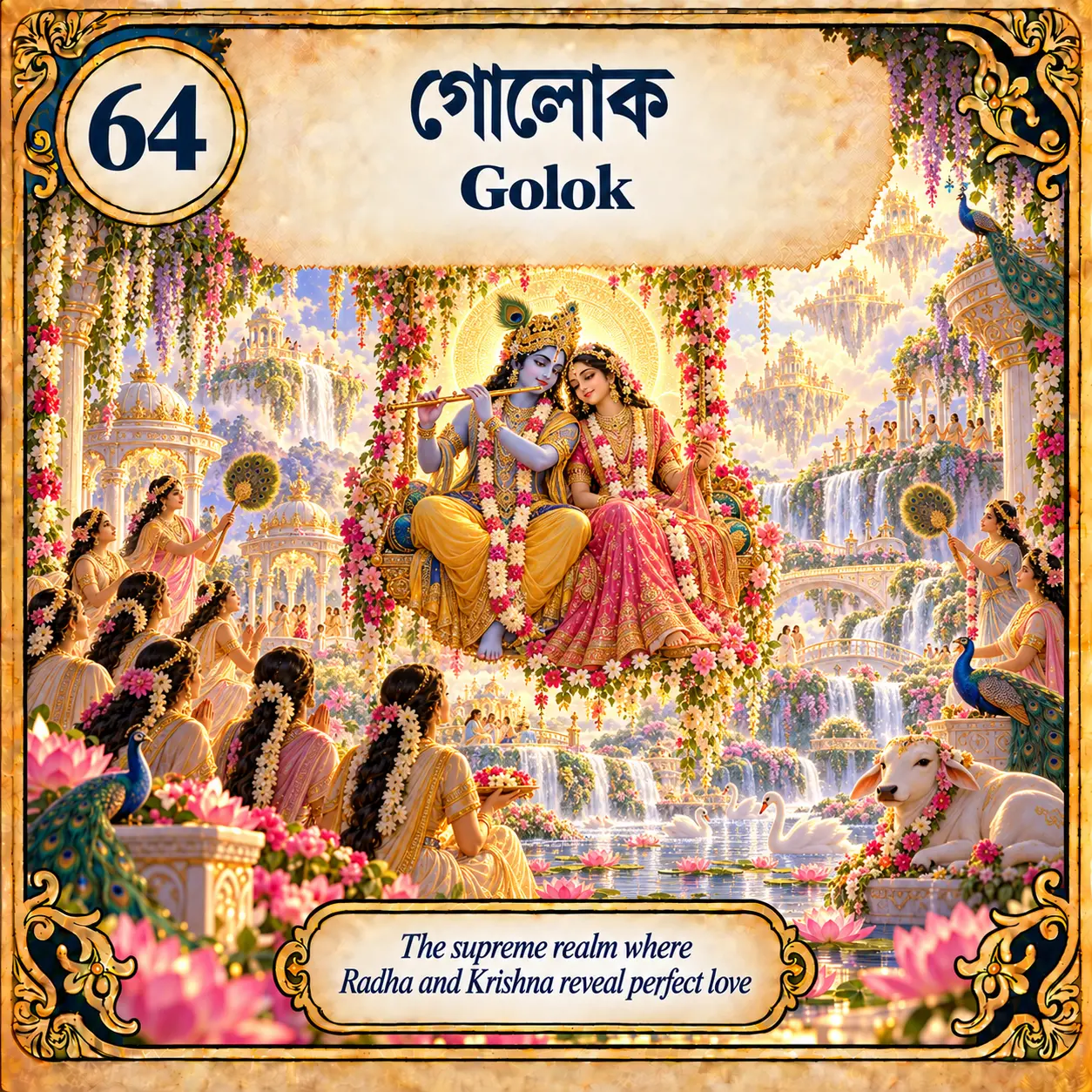
Unlike conventional Gyan Chaupar, Golokdham does not use visible snakes and ladders. Instead, particular cells contain instructions activated by specific cowrie throws.
- advance normally
- suddenly ascend to a much higher cell
- fall dramatically backwards
- be automatically transported by reaching a place
What makes Golokdham distinctly Bengali is its extraordinary mixture of sacred geography and ordinary human existence. The board passes through birth, work, domestic life, cities, pilgrimage centres, forests, mountains, sacred ponds, hellish realms and increasingly subtle celestial worlds.
“Golokdham is not merely a catalogue of virtues and sins. It is a map of human life imagined as a journey through samsara.”
Recorded moments · Dakshineswar
Sri Ramakrishna and Golokdham
29 September 1884 · Dakshineswar
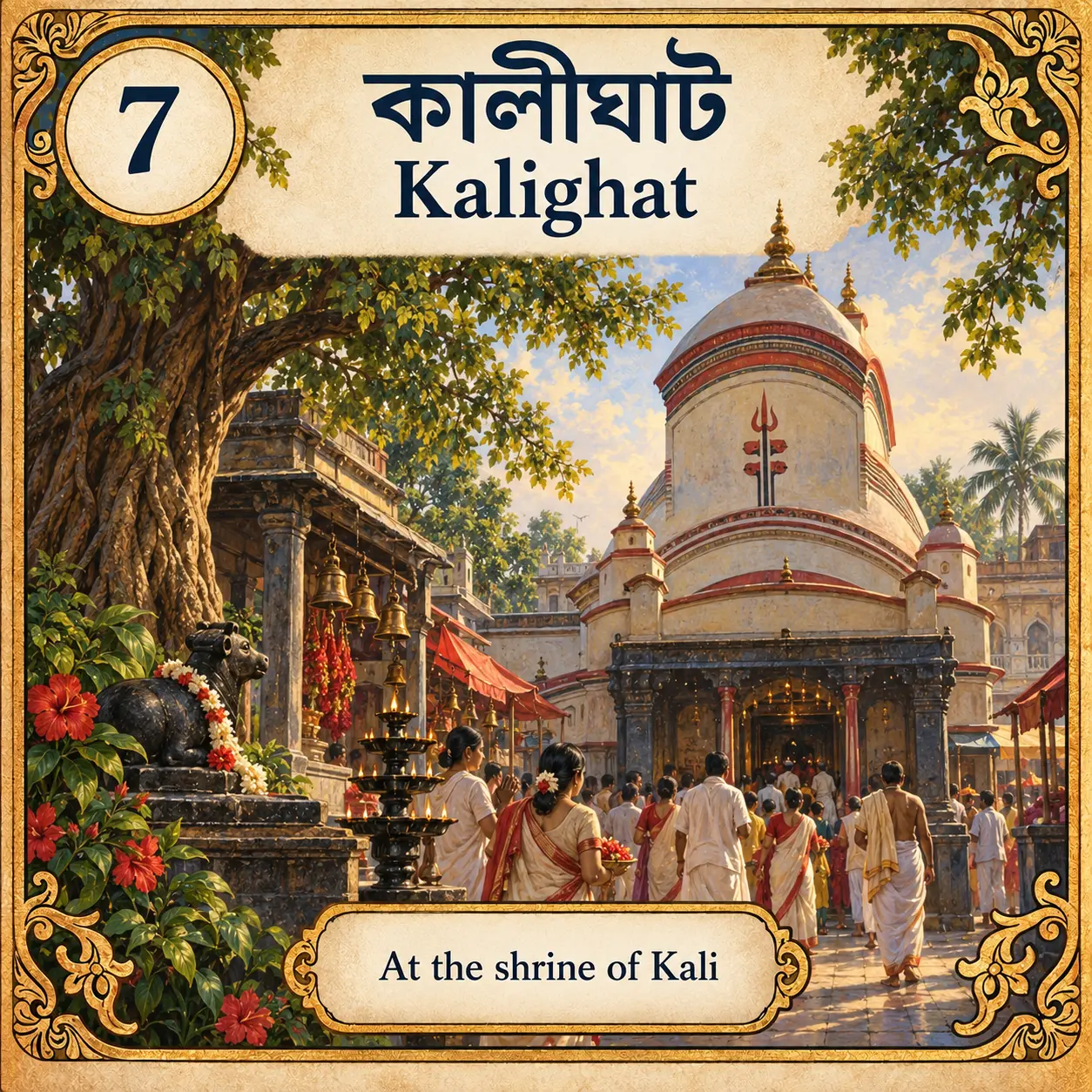
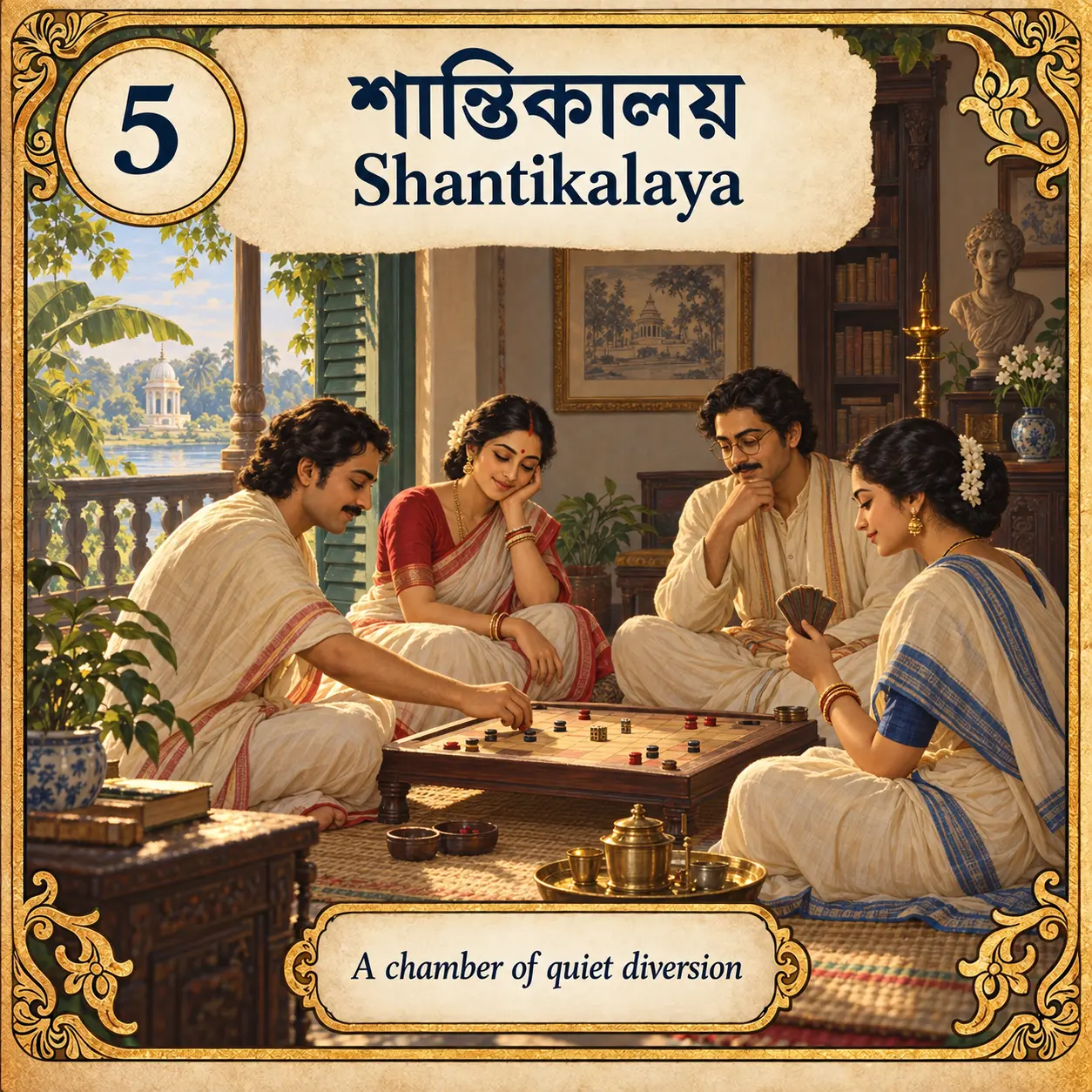
During Durga Puja at Dakshineswar, Sri Ramakrishna’s devotees were playing Golokdham in his presence. M. and Kishori reached “heaven”. Hazra repeatedly landed in “hell”. Latu made an extraordinary ascent from the worldly realm.
Sri Ramakrishna watched his devotees play Golokdham and commented upon the spiritual significance of what occurred during the game.
2 October 1884 · Dakshineswar
Only three days later Sri Ramakrishna referred to Golokdham during a discussion on spiritual progress.
“In the game of golokdham one may advance a great deal, but still somehow one’s piece may fail to reach the goal.”
The statement captures one of the most profound ideas contained within the mechanics of Golokdham. Apparent advancement is not final attainment. A player who seems far ahead may fall. Someone apparently behind may suddenly rise. Position is not the Goal.
From printed board to a disappearing tradition
Golokdham appears to have circulated sufficiently widely in Bengal, particularly around Calcutta, for several printed forms to survive. Historical scholarship records multiple Golokdham types sharing the same broad 64-cell architecture.
Printed versions continued into the twentieth century, but the game gradually disappeared from ordinary play.
What remained were physical boards, museum specimens, literary memories, scholarly descriptions and references such as those preserved in the Ramakrishna literature.
This digital reconstruction
This digital edition attempts to bring that fragmented tradition back into playable form.
- a recovered old Bengali Golokdham board
- manual transcription of its cells and movement instructions
- historical descriptions of Golokdham
- scholarship on Gyan Chaupar and related spiritual journey games
- references in Sri Sri Ramakrishna Kathamrita / The Gospel of Sri Ramakrishna
Editorial note
About this reconstruction
This digital Golokdham is a historically informed reconstruction, not a claim to reproduce every known Golokdham edition.
The surviving tradition includes multiple printed forms and differences in rules and terminology. For this edition, individual cell names and movement instructions have been transcribed from a recovered Bengali Golokdham board and cross-checked wherever possible against historical research.
- Cell 3
- The domestic illustration and movement rule are known, but its historical title remains provisional.
- Cell 49
- The label “Pitrulok / Pretlok” is retained pending definitive reading of the original printed title.
- Cell 40
- The printed instruction names Vrindavan as its destination, although a faint bracketed number conflicts with the confirmed board numbering. This edition follows the named destination: 40 → 34 Vrindavan.
- Cells 62–64
- Shivlok, Vaikunthalok and Golok are the labels chosen for conceptual clarity in this digital reconstruction.
Illustrations. The miniature drawings are modern heritage-style interpretations inspired by the surviving board and its subjects. They are not exact facsimiles of the nineteenth-century artwork.
Research & references
Sources
- Sri Sri Ramakrishna Kathamrita / The Gospel of Sri Ramakrishna. Recorded moments of 29 September 1884 and 2 October 1884. Read the verified 2 October entry.
- Ancient Indian Boardgames Digital Documentation project. Golok Dham entry.
- Anita Bagchi. “Golokdham Khela: Its History and Social Perspective”, Proceedings of the Indian History Congress, Vol. 66. Volume record.
- Andrew Topsfield. Research on Gyan Chaupar and the history of Snakes and Ladders. The Art of Play catalogue record.
- Jakob Schmidt-Madsen. Research on Gyan Chaupar, Golokdham and Indian spiritual board games. Research profile.
“Life is a journey whose outward movement and inward progress are not always the same thing.”