Boards as maps of the world
India has one of the oldest and richest board-game traditions in the world. Its games were played on cloth, carved wood, temple floors and printed paper, and many of them were never merely pastimes: they rehearsed warfare, taught strategy, marked festivals, and in some cases set out a whole philosophy of life.
Several games now played across the world — chess, Ludo and Snakes and Ladders among them — descend from these Indian originals. What follows is a short guide to the most important traditional Indian board games, and to where Golokdham sits among them.
The family of games
Traditional Indian board games
- ChaturangaAncient India
- A war game for four divisions of an army — infantry, cavalry, elephants and chariots. It is widely regarded as the ancestor of chess, which travelled west through Persia as shatranj.
- Pachisi and ChauparNorth India
- Cross-shaped race games played on cloth boards, with cowrie shells (Pachisi) or long dice (Chaupar) deciding each move. Pachisi is the source of the modern game Ludo.
- Gyan ChauparNorth and West India
- The 'Game of Knowledge': a moral and spiritual journey board in which squares stand for virtues, vices and states of being. Its rises and falls became the snakes and ladders of the modern game.
- Moksha PatamSouth India
- A southern name for the same tradition — the 'ladder to liberation' — in which a player climbs toward release from the cycle of rebirth.
- GolokdhamBengal
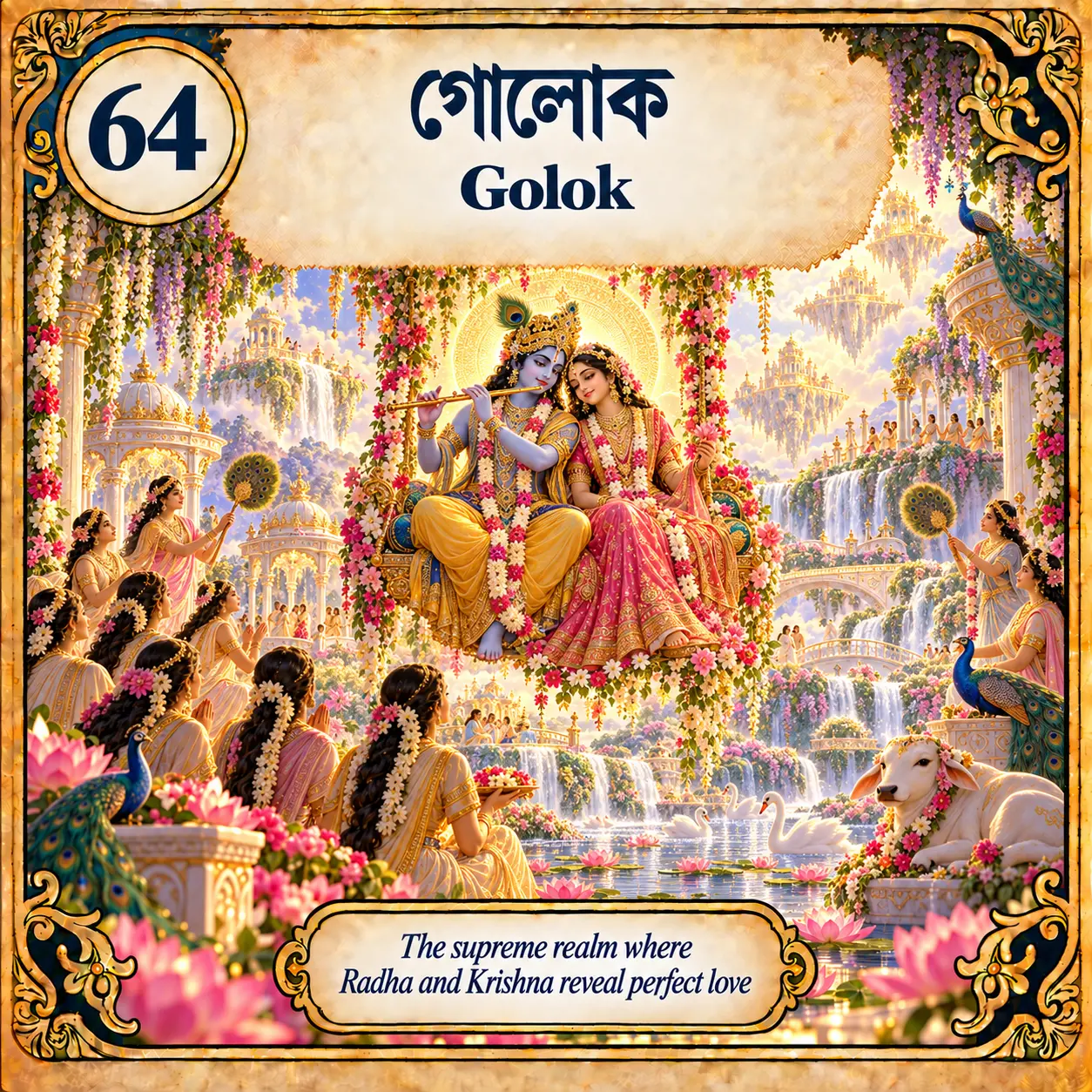
- A nineteenth-century Bengali transformation of the spiritual journey game: 64 cells rising through birth, work, pilgrimage and celestial realms to Golok, with no drawn snakes or ladders and seven cowries as dice.
- PallanguzhiTamil Nadu and Kerala
- A mancala game of sowing and capturing seeds or shells across a wooden board of pits, traditionally played by women at home and during festivals.
- Aadu Puli AttamSouth India
- The 'goat and tiger game': a hunt game in which a few tigers try to capture goats while the goats try to surround and trap the tigers.
“In the spiritual journey games, the board is not a battlefield or a race track but a map of the soul's passage.”
Where Golokdham belongs
From Gyan Chaupar to Golokdham
Golokdham belongs to the spiritual branch of Indian board games — the Gyan Chaupar family. It keeps the old idea of a journey through samsara toward liberation, but reshapes it into a distinctly Bengali board of sacred geography and everyday life, printed in Calcutta in the later nineteenth century.
Instead of snakes and ladders, particular cells send a piece up or down only on certain cowrie throws, and a few places carry the pilgrim onward automatically. The goal is Golok, the abode of Krishna, at the apex.
You can play this reconstruction free: on one device, online with friends from the home page, or read its history and rules. Unfamiliar words are explained in the glossary.